Wednesday, December 15, 2010

Review: BLACK SWAN

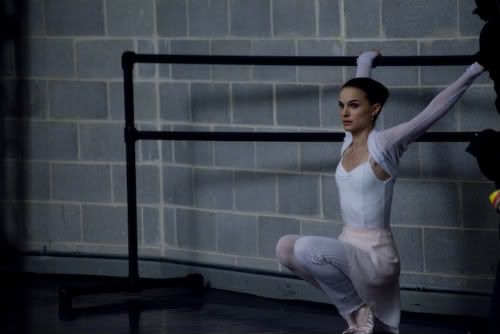
In 2008, Darren Aronofsky told the compelling story of an aging professional wrestler fighting to keep his career alive. Now, in 2010, he tells the story of a young ballerina fighting to rise to stardom with her only obstacle being herself.

Black Swan centers on Nina Sayers (Natalie Portman), a 20-something year-old professional ballerina living in New York City with her overbearing mother (Barbara Hershey). Because of her timid, perfectionist nature, Nina has never been a featured dancer in any of her company’s performances. However, with prima ballerina Beth MacIntyre (Winona Ryder) being asked to retire, the part of the Swan Queen in the company’s production of Swan Lake is given to Nina, despite director Thomas Leroy’s (Vincent Cassel) hesitation. As Nina struggles to channel the dark, uninhibited Black Swan, she develops a strange, rivalrous friendship with Lily (Mila Kunis), a free-spirited dancer who is new to the company and much more fit for the role of the Swan Queen. The pressure Nina puts on herself, fueled by Thomas and her mother, causes her to completely lose touch with reality by the opening night of the show.


This film proves itself to be a compelling, highly stylized psychological thriller driven by Aronofsky’s direction and Portman and Kunis’s performances. Aronofsky’s vision is daring yet timeless, a balance achieved through a mixture of classic symbolisms and manic plot movements. The way he shadows Nina with his lens rather than watching her from afar puts the audience in the thick of her downward spiral, setting the film’s suspenseful tone. In addition, Portman’s turn as the disturbed ballerina is nothing less than enthralling from beginning to end and her chemistry with Kunis exudes raw, organic emotion. I cannot give enough credit to these three major players because they all faced the challenge of a script lacking in passion. Much of the dialog, especially in the film’s opening scenes, is far too cut-and-dry and worn thin by cliché. Portman and Kunis succeed in overcoming this problem, however, Hershey and Cassel struggle to even get their performances off the ground. Though Black Swan as a whole manages to rise above this hiccup, I cannot help but wish that the script had been as strong as the rest of the film’s components.

In my opinion, Aronofsky’s commentary on the dangers of striving for control and perfection makes Black Swan 2010’s most haunting film. You cannot help but fall victim to its tantalizing grip.


Rating: 5/5

Tuesday, November 2, 2010

Review: WAITING FOR "SUPERMAN"


Sometimes movies are not meant to entertain. Sometimes they are meant to open eyes. Such is the case for Waiting For “Superman,” recipient of the Best Documentary award at the 2010 Sundance Film Festival.

Waiting For “Superman” dedicates itself to the sad state of public education in America, following five young students as they struggle to earn the education they deserve in the face of hardship. Director and narrator Davis Guggenheim takes his audience through the students’ rough streets of Harlem, Washington D.C., and Los Angeles and asks, “do our country’s ongoing social and economical problems stem from our educational system?” With interviews from social activist/educator Geoffrey Canada and former chancellor of D.C. public schools Michelle Rhee fueling the film, Guggenheim is able to present facts and figures that seek to answer this question.

If ever there was a subject to deeply upset me, this is the one. As a student who was fortunate enough to attend decent public schools in decent settings, I never really had to worry about being let down by my teachers the way the kids featured in this documentary do. Throughout most of the film, Guggenheim does well to inform the audience without playing the violin too loudly, a balance that is difficult to find when discussing something so heartbreaking. The statistics he offers, often accompanied by creative animations, are used to keep up momentum while serving as a breather from the depressing interviews given by the students and their parents. However, the balance falls off by the final 30 minutes of the film when the only content invading the screen is shot after shot of (the majority of) the students being denied entry into better schools. This addition plays on the audience’s emotions and detracts from the rest of the documentary, making Guggenheim come off as a less angry, more sympathetic Michael Moore. In the end, I felt like I could have learned more if I hadn’t been so distracted by the film’s final notes.

I wouldn’t recommend rushing out to the theater to catch this documentary, but it is a definite must-rent. The subject may be grave, especially when shown through Guggenheim’s lens, but it is one that must be addressed.


Rating: 4/5

Tuesday, October 26, 2010

Review: PARANORMAL ACTIVITY 2


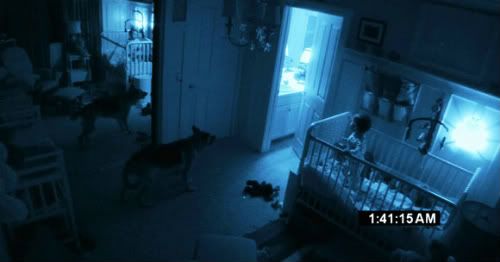
It’s a pretty typical Hollywood story: low budget, independent film becomes a surprise success; big name studio buys the rights for dirt cheap; franchise is born. Such is the case for Paranormal Activity, 2009’s small “found footage” horror flick that is powered by two unknown actors and a video camera. Now, a year later, Paramount has given birth to Paranormal Activity 2, assigning a new director and a more bloated budget to the task of producing quiet, resonating terror.

Paranormal Activity 2 is both a prequel and a sequel, its plot working in conjunction with last year’s sleeper hit. This time around, home movies and surveillance footage follow Kristi Rey (Sprague Grayden) and her family as they experience-yep, you guessed it-paranormal activity in their home. So, how does this follow-up coincide with its predecessor? Kristi is both neighbor and sister to Katie (Katie Featherston), the victim of demonic torment in the original film. However, Katie has yet to fall victim to evil because Paranormal Activity 2 begins a few weeks before the first film...and she was never meant to fall victim in the first place.

I’ll admit it: this film unnerved me, but it wasn’t because of its relentless jump scares or its run-of-the-mill central storyline. The way it answers questions I never even thought I wanted answers to (despite the “winking” exposition it uses to get from point A to point B) is what left me chilled as I walked out of the theater. That being said, it was the only thing that left me chilled. The rest of Paranormal Activity 2 plays out far too predictably, with two-dimensional stock characters who only serve to move the plot along and constant spooks that become more annoying than frightening half way through. Paramount hardly lets this quickly produced follow-up remain subtle like Paranormal Activity proved itself to be and because of that, it suffers immensely.

Do the terrors outweigh the yawns? In my opinion, yes. If you are a fan of the first film, at the very least you will probably somewhat appreciate how this one intertwines with it. But be warned: it’s muddled with plenty of throwaway content and, though it goes without saying, it hardly breaks any new ground.


Rating: 2.5/5

Monday, October 18, 2010

Review: CATFISH

The new documentary, Catfish, has caused a near uproar regarding its validity. Is it really a documentary or is it just masquerading as one? Is it really “the best Hitchcock film that Hitchcock never directed” or will it deliver a lackluster outcome? Before you get too tangled up in hesitation, let me ask you this: does the story’s authenticity really even matter if the subject still rings true?

Unknown filmmakers Henry Joost and Ariel Schulman center Catfish on Nev Schulman, a 24-year-old photographer living in New York City, and his blossoming internet friendship with a family from Michigan. The correspondence begins when Abby, an eight-year-old artist, sends Nev a package containing an oil painting of hers based on a recently published photo of his. Nev gets in touch with Abby’s mother, Angela, on Facebook and starts to learn about their family, all the while sending his pictures to Abby for her to paint for him. He becomes friends with Abby’s father and brother as well and even strikes up a courtship with her older sister, Megan. However, Nev discovers inconsistencies in some of the family members’ stories and decides to step back from the situation and do some investigating, which ultimately leads him to Michigan and forces him to face the truth.

The controversy surrounding this film’s authenticity proves to be completely irrelevant because, whether or not it is actually a documentary,Catfish speaks volumes about how we as a culture so often blur the line between internet and reality. In a way, Nev takes a risk by placing himself in the in-between for the sake of mass revelation. The sole purpose of this film is to get its audience to ask questions and seek out answers, which I believe it does masterfully. Everything else that I love about the film-from its use of Google Maps as an aesthetic touch to its concentration on even characters’ most minor reactions-is merely a bonus.

Though I think Catfish has a shot at holding quite a bit of cultural value, if only temporarily, it will no doubt leave some viewers feeling less than satisfied. The marketing campaign behind this film indicates that it will be this year’s Paranormal Activity, however, it does not deliver any horrific scares and the “Hitchcockian twist” it boasts is only a plot development. Unfortunately, the film’s misleading insinuations will ultimately overshadow its true nature and keep it from resonating with disappointed moviegoers.

If you are interested in films that have something valuable to say, I highly recommend Catfish. It may not completely embody the tone it appears to upon first glance, but it still haunts, if only in the unusual sense of the term.


Rating: 4/5

Monday, October 11, 2010

Review: IT'S KIND OF A FUNNY STORY


Ever since the success of 2007’s Juno, Hollywood has been rapidly spitting out mainstream indie films in hopes of attracting the same praise. However, a pattern has appeared: only one film in the genre stands out each year. Last year it was 500 Days of Summer, a film that benefitted from its incessant commercial spots and likable stars. Attempting to follow in suit, will It’s Kind of a Funny Story garner similar praise?

It’s Kind of a Funny Story opens with 16-year-old Craig (Keir Gilchrist) biking to a New York City emergency room at five in the morning after waking up from a dream in which he commits suicide. The overwhelmed teen convinces the on-call doctor to help him out, thinking that a quick fix is available to him. However, he soon finds out that his stay in the third floor psychiatric ward will be a minimum of five days, setting him behind on schoolwork and tying him up in fibs to his friends. Though Craig feels out of place at first, he finds a confidant in Bobby (Zach Galifianakis), a love interest in Noelle (Emma Roberts), and a new appreciation for everything he has.

Every problem that I have with this film stems from its poorly written screenplay, which is essentially a mishmash of stale characters whose problems are given all-too-convenient resolutions. Craig comes off as a cliche, devoid of any unique traits that would at least make him a somewhat sympathetic character. In fact, all of the teenagers featured suffer from the same fate. Their dialog feels unnatural and makes clear to the audience that they are really actors playing teenagers who are trying so hard to be typical teenagers. With the exception of Bobby, who is allowed the chance to develop a distinct personality, the adults in the film are no better off than their younger co-stars. So much time is spent on these bland characters that the film’s central topic, depression, becomes a lighthearted afterthought and, in the end, gets treated like a fleeting speed bump standing in the way of a perfect life. If these elements would have been considered more thoroughly, It’s Kind of a Funny Story would have had a chance at being something fresh, but sadly, they were not.

Though I took issue with most of this 100 minute public service announcement, I cannot dislike it because it is just too nice. The mainstream indie style will have mass appeal, as will Galifianakis’s performance. My advice? See a matinee showing with your mom and little sister, but don’t be fooled: the story isn’t really as funny as you want it to be.


Rating: 2.5/5

Monday, October 4, 2010

Review: THE SOCIAL NETWORK

What do you get when you create a film based on the rise of one of the most popular websites in Internet history? A box office success. And if that film is the brainchild of David Fincher and Aaron Sorkin? A critical success. “The Facebook movie,” as it has been dubbed, has received acclaim from all directions, and for good reason.

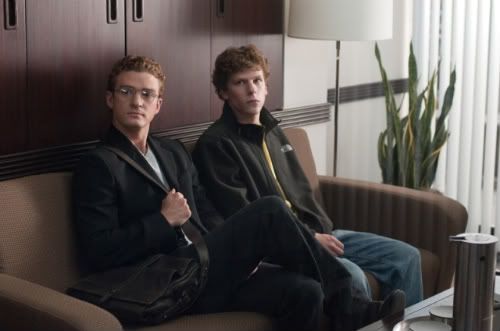
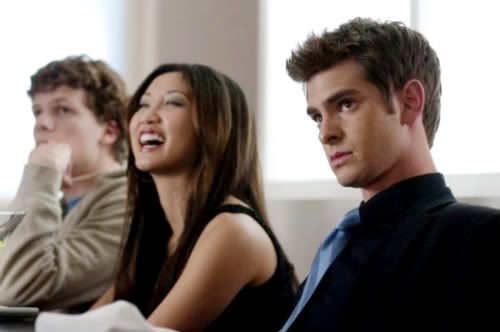
The Social Network, as it is formally entitled, chronicles the rise of Facebook and how it affected its founders. Mark Zuckerberg (Jesse Eisenberg), a sophomore at Harvard looking to be accepted into one of the prestigious clubs on campus, makes his mark by masterfully hacking into the school’s computer system and creating a prank website with its content. His actions garner the attention of twin brothers Cameron and Tyler Winklevoss (both played by Armie Hammer), who offer him the task of programing a website they have been working on launching. Mark accepts the offer but deflects the brothers’ attempts at getting together to begin construction, all the while building on their idea and creating “the facebook.” With the financial help of his best friend, Eduardo Saverin (Andrew Garfield), Mark starts the phenomenon that earns him both followers and enemies.


This film proves to be nearly flawless in all aspects, the main reason being the collaboration between Fincher and Sorkin. Fincher knows how to capture tone with his camera, paying careful attention to the characters’ facial expressions and interactions with their settings. Sorkin’s snappy dialog never quits. In fact, the screenplay is so well written that it serves as its own outstanding performance, though it never once overshadows the actors’ achievements. Eisenberg delivers an especially memorable performance as Zuckerberg and is in good company alongside Garfield, Hammer, and Justin Timberlake (who plays the conniving founder of Napster, Sean Parker). To complete the package, the film’s score (developed by Trent Reznor of Nine Inch Nails fame) compliments the overarching theme of deceit with its ominous inflections, thus bringing Fincher’s vision full circle.

Despite being two hours of pure dialog, The Social Network stands as a compelling, relevant testament to this day and age. Its commentary on technology as it relates to social standing and human connection resonates long after the closing credits.


Rating: 5/5

Wednesday, September 22, 2010

Review: THE TOWN

A crime drama must be handled delicately. An overabundance of action can cheapen it; too many lines of dialog can make it drag. A balance must be found in order for it to satisfy. And if balance can’t be found, are nuns with machine guns enough?

After 2007‘s Gone Baby Gone, Ben Affleck is back with his sophomore venture, The Town. Affleck steps in front of the camera this time, playing Doug, a career bank robber from the rough neighborhood of Charlestown in Boston. He and his long-time friends-Jem (Jeremy Renner), Dez (Owen Burke), and Gloansy (Slaine)-hit a Cambridge bank and end up taking the manager, Claire (Rebecca Hall), hostage. Though they free her unscathed, Jem confiscates her driver’s license and employs Doug to follow her, making sure she doesn’t remember any details that will compromise their life of crime. Doug and Claire begin dating and Claire divulges her memories of the robbery to him, along with the fact that she has been in contact with the FBI agent handling the case, Frawley (Jon Hamm). With Jem planning more robberies, Frawley hot on his trail, and his feelings for Claire progressing, Doug finds himself caught in a game of cat and mouse when all he wants is a fresh start in a new place.


The tone of The Town is set by its well-paced plot and suspenseful action sequences. Affleck fluidly introduces characters and situations that let his audience know just what kind of hell Charlestown is, why anyone would want to flee but few feel like they can. Scenes packed with rapid gunfire are balanced by ones that are more dialog-heavy, keeping this crime drama on point with its genre. As for performances, Jeremy Renner takes the top prize with his turn as Jem. He clearly commits himself to the role, never losing sight of Jem’s motivations and desires. These natural, effortless elements give this film its edge.

Despite its strong, compelling beginning, The Town fizzle out due to how muddled it becomes. The plot is on point, but the writing leaves much to be desired. Seemingly important characters introduced in the first half-hour, most namely Krista (Blake Lively) and Fergie (Pete Postlethwaite), do not reappear in any meaningful way until the final 45 minutes, leaving them underdeveloped. An excessive amount of time is spent focusing on the relationship between Doug and Claire, a relationship that never really proves itself to be genuine. Doug spews out hokey line after hokey line trying to win over his damsel in distress, leading the film to a weak, sour ending. The audience is left questioning far too much.

The Town managed to win me over with its thrilling robberies and the men behind them, however, it left me wishing for a consistent script and believable bonds between characters. The flaws are apparent, but it still succeeds.


Rating: 3.5/5